Choosing a Vision Jet isn’t simply about finding the newest aircraft or the one with the lowest asking price. The right Vision Jet is the one that best matches the way you actually fly. They are very fun to fly and your passengers will love the cabin experience…
For prospective Cirrus Aircraft SF50 Vision Jet owners, the most important question isn’t “Which Vision Jet should I buy?” It’s:
“What do I need this airplane to do for me?”
At SF50 Flight Support, we believe the aircraft acquisition process should begin with the owner’s mission—not with a particular serial number.
Start With Your Mission
Every owner uses an aircraft differently.
One owner may primarily fly two people 500–700 miles several times a month. Another may regularly carry five passengers, luggage and golf clubs on 1,000-mile trips. Another may need the airplane primarily for business travel, while a family may value cabin comfort and flexibility above all else.
Before looking at aircraft for sale, consider:
- How many people will typically fly?
- How far do you normally travel?
- How frequently do you fly?
- What airports do you use?
- Do you routinely encounter high terrain?
- How important is speed?
- How much luggage do you carry?
- Do you need single-pilot capability?
- How important are avionics and connectivity?
- What level of maintenance predictability do you want?
- How long do you intend to own the aircraft?
These answers establish your mission profile.
Passenger Count Matters
One of the biggest mistakes buyers make is planning around the maximum seating capacity rather than their typical mission.
A Vision Jet can be remarkably capable for its size, but passengers, baggage and fuel all compete for available payload.
If most of your trips involve two or three people, you may have considerably different requirements than an owner who routinely carries five or six passengers.
Consider your normal passenger load, not your once-a-year maximum.
For example:
Mission A:
Two passengers + light baggage + 500-mile trips
Mission B:
Five passengers + baggage + 1,000-mile trips
Both owners may want a Vision Jet—but they may prioritize different aircraft characteristics, equipment and operating considerations.

Range Isn’t Just a Number
Published range numbers are useful, but they don’t tell the entire story.
Your real-world mission is affected by:
- Passenger and baggage weight
- Fuel requirements
- Winds
- Temperature
- Cruise altitude
- Departure airport elevation
- Routing
- Alternate requirements
- Reserve strategy
- Runway requirements
Instead of asking:
“How far can the Vision Jet fly?”
Ask:
“Can this aircraft comfortably fly my typical mission with the passengers, baggage, weather and reserves I require?”
That’s a much better question.
Think About Your Airports
Your home airport is one of the most important factors in choosing an aircraft.
Look at the airports you actually use—not just your home base.
Consider:
- Runway length
- Elevation
- Temperature
- Instrument approaches
- FBO availability
- Hangar availability
- Maintenance support
- Weather patterns
- Terrain
- Airspace congestion
A Vision Jet may be an excellent fit for an owner whose normal destinations are large and medium-sized airports. Another owner may place greater emphasis on operating into smaller regional airports.
Your airport network should be part of the aircraft-selection process.
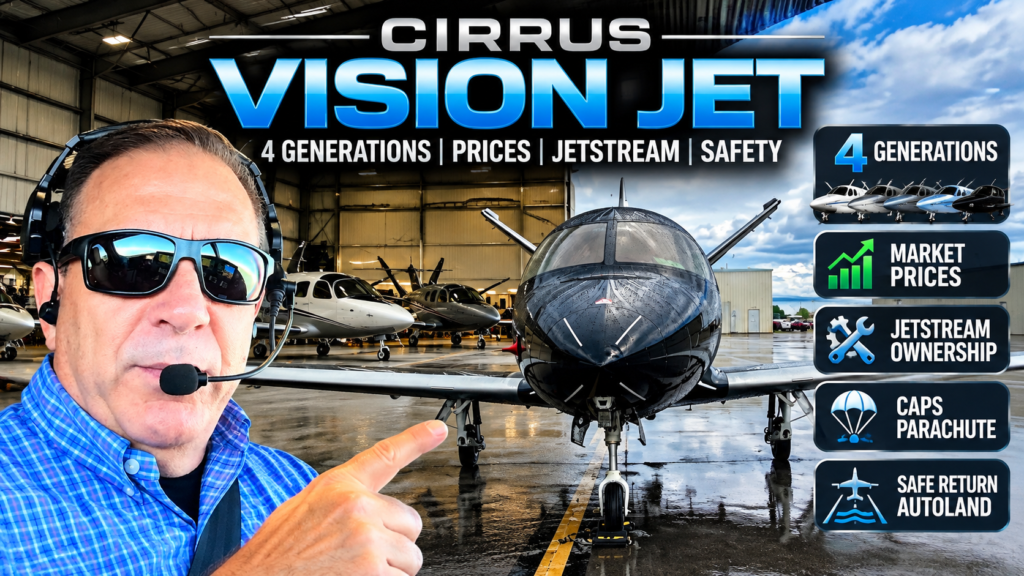
G1, G2, G2+ or G3?
For Vision Jet buyers, model generation is obviously an important consideration, but its is the key contributor to acquisition cost.
But newer isn’t automatically better for every buyer, for similar reasons. The G1, G2, and G2+ were designed with up to five adult seats and two additional seats with ninety pound weight limitations. The G3 was designed for six adults as a result of the bench seat in the third row. Realistically, six average sized adults on a G3 Vision Jet flight can travel around 200 miles. This makes for a long day of travel if your plans are to cover 1500 miles, due to needing somewhere around seven fuel stops… Not an ideal mission for the Vision Jet.
That being said, the typical Vision Jet mission is three average sized adults and around 600 miles. All current versions of the Vison Jet have this endurance. Also remember this is a two hour flight without restroom facilities… I’ve found the passenger bladders fill about the same time I reach my IFR reserve. Perfect integration of performance, human and machine.
My longest Vision Jet flight was nearly four hours between Boston and Nashville. I was the only one on board and still landing with a legal IFR reserve.
A newer aircraft may provide updated avionics, equipment and features, while an older aircraft that has been properly maintained and upgraded may offer an attractive combination of capability and value.
When comparing Vision Jets, look beyond the year on the registration.
Evaluate: All Criteria – we can help!
Two aircraft of the same model year can have very different values.
Don’t Underestimate the Importance of Equipment
Your mission should determine which equipment matters to you.
For example, an owner who regularly flies longer business trips may place significant value on connectivity and avionics upgrades.
Another owner may prioritize:
- Passenger comfort
- Interior configuration
- Wi-Fi
- Updated avionics
- Enhanced weather capability
- Additional operational equipment
The key is to determine which options actually improve your mission before paying a premium for them.
Consider How You Will Operate the Aircraft
Another important question is who will fly the Vision Jet?
Some owners intend to fly themselves. Others want a professional pilot available for every trip. Some want a combination of owner-pilot and contract pilot operations.
That decision can affect:
- Training requirements
- Scheduling
- Insurance
- Operating costs
- Aircraft availability
- Trip flexibility
If you intend to fly the aircraft yourself, consider not only whether you can fly the mission, but whether you are comfortable doing so in the conditions you regularly encounter.
Your aircraft should support your operating philosophy—not force you into one.
Buy the Aircraft, Not Just the Price
One of the most important lessons in aircraft acquisition is that purchase price is only one component of value.
A $3 million aircraft that requires significant upcoming maintenance, upgrades and corrective work may ultimately cost more than a $3.2 million aircraft that is better positioned for the next several years. The JetStream program does provide comprehensive coverage and owner peace of mind, but does not cover damage, previously poor operation, or aesthetic updates.
When comparing aircraft, look at the total acquisition picture:
**Purchase price
- pre-buy findings
- deferred maintenance
- upcoming inspections
- required upgrades
- engine/maintenance program considerations
- interior/exterior work
= actual acquisition cost**
This is where professional aircraft evaluation can provide significant value.
Your Mission May Change
Don’t choose an aircraft based solely on today’s mission.
Think about how you expect to use it over the next three to five years.
Perhaps today you primarily travel with one passenger, but your family is growing.
Perhaps your business travel is increasing.
Perhaps you’re retiring and expect to fly more for leisure.
Or maybe you’re purchasing your first aircraft and aren’t yet sure how your flying will evolve.
A good aircraft acquisition strategy accounts for both your current mission and your expected future mission.
The Best Vision Jet Is the One That Fits You
There is no single Vision Jet that is perfect for every owner.
The right aircraft depends on your:
Mission + Passengers + Range + Airports + Equipment + Budget + Operating Strategy
That’s why aircraft shopping should begin with a mission analysis rather than a list of aircraft currently for sale.
At SF50 Flight Support, our goal is to help Vision Jet buyers make an informed decision based on how they actually intend to use the aircraft.
We can help evaluate the mission, identify the characteristics that matter, compare available Vision Jets and provide an experienced operational perspective throughout the acquisition process.
Don’t start by asking which Vision Jet you should buy.
Start by asking what you need your Vision Jet to do.
Once you understand the mission, the right aircraft becomes much easier to identify.
Contact SF50 Flight Support
Choosing the right Vision Jet starts with understanding your mission. If you’re considering purchasing a Vision Jet or want an experienced perspective on a particular aircraft, SF50 Flight Support can help you evaluate the aircraft based on how you intend to use it.
Whether you’re just beginning your search or have already identified an aircraft, we’re available to discuss your mission, aircraft requirements and acquisition strategy.
SF50 Flight Support, LLC
Making Vision Jet Ownership Better
📞 Phone: 615-543-8553
✉️ Email: info@sf50flightsupport.com
🌐 SF50FlightSupport.com
Ready to find the Vision Jet that fits your mission? Contact us today.