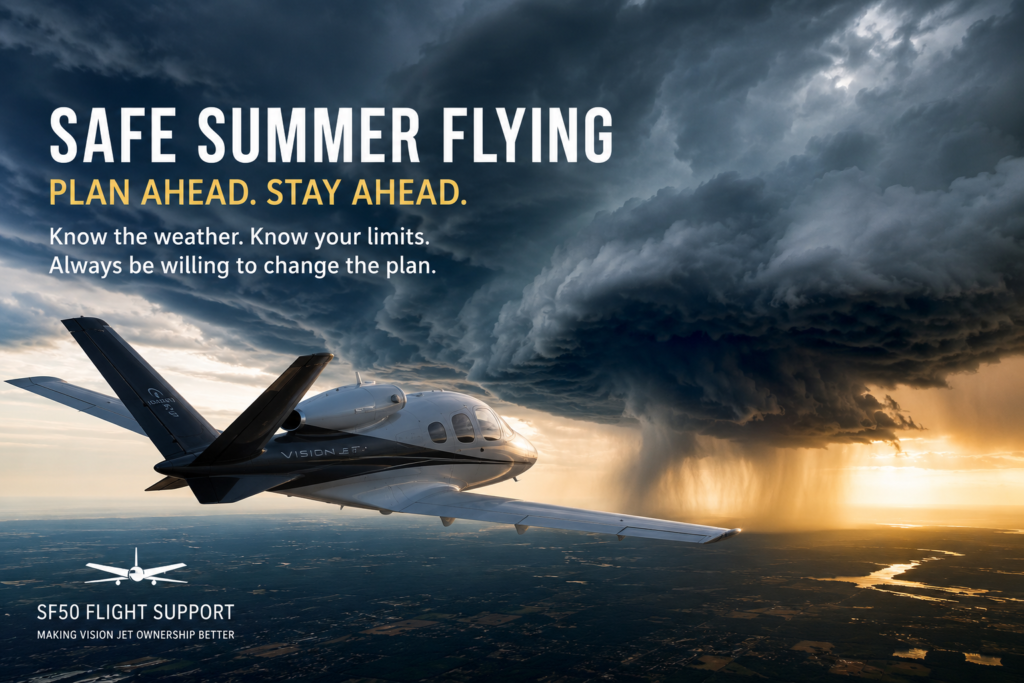
Even through seasons will soon be changing, summer is one of the busiest times of the year for general aviation. More flying means more opportunities to enjoy the airplane—but summer also brings unique challenges that can quickly turn a routine flight into a demanding one.
The Vision Jet provides exceptional performance for a single engine jet, and capability, but it does not eliminate the fundamental risks associated with summer weather, aircraft performance, pilot workload, and decision-making.
Before your next summer flight, consider these ten areas.
Be sure to check out PLANEWX! The weather watchdog for all of your flights. This link will get you a free 14-day trail. Some plans are free, but the pro version will provide additional features and worth every penny.

1. Know When to Say No
Perhaps the most important summer-flying skill is knowing when to cancel, delay, or divert.
Weather can change quickly. Thunderstorms can develop faster than expected. Passengers may be anxious to reach their destination. Schedules can create pressure.
None of those factors changes the weather.
Ask yourself:
“If I were not already committed to this flight, would I choose to launch it right now?”
If the answer changes during the flight, don’t be afraid to change the plan.
Aviation rewards conservative decision-making.
2. Don’t Forget to Assess Density Altitude
Hot summer temperatures reduce air density.
Higher density altitude means reduced aircraft performance, including acceleration and climb capability. The effect becomes particularly important when operating from high-elevation airports or when temperatures are unusually high.
Before departure, consider:
- Aircraft weight
- Outside air temperature
- Pressure altitude
- Runway length
- Runway slope
- Wind
- Obstacles
- Climb performance
- Destination and alternate conditions
The Vision Jet has impressive performance, but performance calculations still matter.
Don’t let an impressive aircraft performance envelope replace actual performance planning.
3. Respect Thunderstorms
Summer thunderstorms can develop rapidly and contain extreme turbulence, hail, lightning, wind shear, microbursts, and potentially tornadoes.
One of the most important rules is simple:
Don’t try to “thread the needle” between developing cells.
Remember that NEXRAD information isn’t necessarily a real-time picture of what is happening ahead of you. Weather radar products, like NEXRAD, can contain latency, meaning the weather displayed on your screen may not represent its actual location or intensity. Remember to use NEXRAD for strategic weather, and onboard radar for tactical weather.
The objective is to identify developing weather early, establish an escape or diversion plan, and maintain generous margins.
4. Take Care of the Pilot
Summer flying can be physically demanding.
Heat, dehydration, fatigue, and inadequate rest can degrade judgment and reaction time.
The IMSAFE checklist remains a useful personal preflight tool:
I — Illness
M — Medication
S — Stress
A — Alcohol
F — Fatigue
E — Emotion
A pilot who is tired, dehydrated, or mentally distracted may not recognize the degradation in performance until workload increases.
5. Have an Emergency Plan Before You Need One
Emergencies rarely occur at convenient times.
Think through scenarios such as:
- Engine abnormalities
- Pressurization problems
- Smoke or fire
- Severe turbulence
- Rapidly deteriorating weather
- Loss of communications
- Navigation or avionics failures
- Unexpected runway closures
- Passenger medical emergencies
The goal isn’t to anticipate every possible emergency.
The goal is to build the habit of thinking ahead.
6. Stay Ahead of Runway and Taxiway Risks
Summer brings increased traffic to many airports.
That means more airplanes on the ramp, more complicated taxi situations, and greater potential for runway incursions.
Review the airport diagram. Know your position. Listen carefully to taxi instructions. Don’t hesitate to request progressive taxi if necessary.
Modern Vision Jet avionics can be an enormous asset, but technology shouldn’t replace situational awareness.
Know where you are before ATC has to tell you.
7. Look Beyond the Radar Picture
Thunderstorms aren’t the only summer weather concern.
Wind shear, rapidly changing fronts, temperature inversions, turbulence, and localized airport weather can all affect a flight.
Pay particular attention to the transition from seemingly benign conditions to rapidly deteriorating weather.
A flight that looks excellent at departure can become significantly more complicated an hour later.
Understanding the big weather picture is more valuable than simply looking at the next radar image.
8. Currency Isn’t the Same as Proficiency
Being legal to fly doesn’t necessarily mean you are proficient.
For Vision Jet pilots, proficiency should include more than simply maintaining regulatory currency.
Consider regularly practicing:
- Abnormal and emergency procedures
- Engine failure scenarios
- Instrument approaches
- Missed approaches
- Go-arounds
- Weather deviations
- High-workload arrivals
- Automation failures
- Loss of communications
- Diversion decision-making
The best time to practice an emergency is when nothing is going wrong.
9. Know What Your Instruments Are Telling You
A good pilot understands not only what the instruments indicate, but how they work and what a failure looks like.
For a highly automated aircraft such as the Vision Jet, this principle extends to the entire avionics system.
Don’t simply know what the display says.
Know what the airplane is actually doing.
10. Don’t Let the Airplane’s Capability Outrun Your Decision-Making
The Vision Jet is an extremely capable aircraft. That capability can sometimes create the temptation to continue a flight when conditions are deteriorating.
The airplane may be capable of continuing. That doesn’t necessarily mean you should.
A conservative decision made early is almost always better than a difficult decision made late.
The Bottom Line
Summer flying isn’t inherently dangerous—but it demands good preparation and disciplined decision-making.
For the Vision Jet pilot, the priorities should be:
Stay ahead of the weather.
Know your airplane.
Understand performance.
Maintain proficiency.
Take care of yourself.
And always have an exit strategy.
The safest pilot isn’t necessarily the one who can handle the worst conditions.
It’s the one who recognizes deteriorating conditions early enough that handling them never becomes necessary.
Plan early. Stay ahead of the weather. Know your limitations. And always be willing to change the plan.