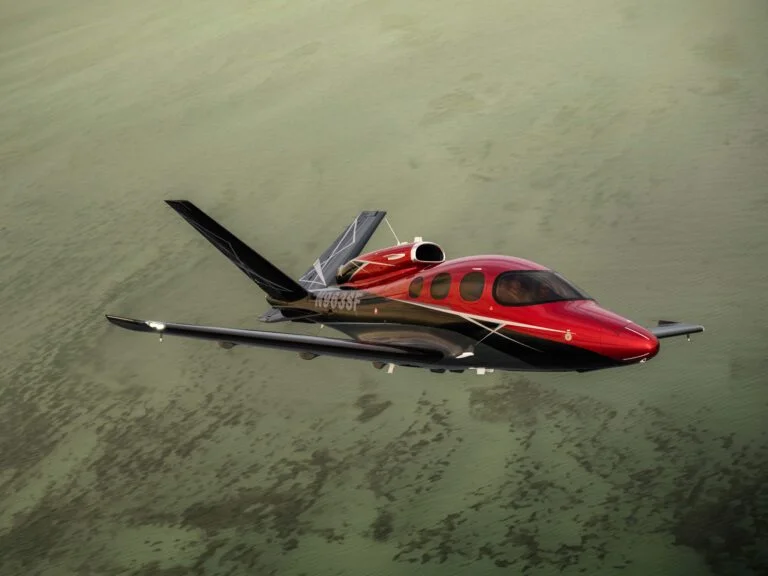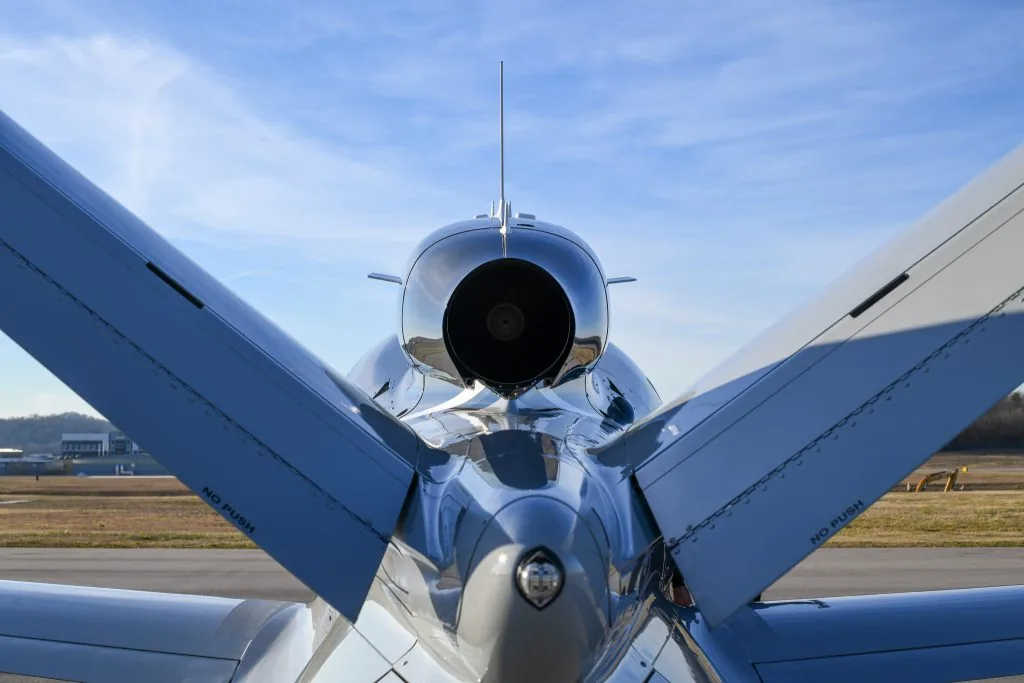
Pretty Impressive Specifications…
Cirrus Aircraft recently delivered the 500th Vision Jet, stating:
The Vision Jet has the capabilities and comforts that can achieve many of the missions that larger corporate jets do at significantly smaller operating costs making it the ideal supplement to every corporate fleet. The Vision Jet adds flexibility for short regional and longer cross-country missions with lower fuel burn due to its innovative single-engine and V-tail design. All Vision Jets can be powered by SAF fuel as well. According to Conklin & De Decker, the Vision Jet has the lowest CO2 emissions rate compared to all general and business aviation jets.
The name “Vision Jet” was an excellent choice when you experience the view from the cockpit. There were other names contemplated as the Vision Jet was developed and certified.
From June 2006 to July 2008, the design was developed under the project name “The Jet”, or “The-Jet by Cirrus”. On July 9, 2008, Cirrus announced the marketing name of “Vision SJ50”, with “V” for the V-tail and “SJ” for “single-jet”. By March of 2009, the aircraft was re-designated as the “Vision SF50”, as it uses a single-fanjet engine. By April 2016, Cirrus was calling it the “Vision Jet” and on October 28, 2016, it was certified as the “Model SF50”.
The SF50 Vision Jet was purpose built as a transition turbine aircraft from piston-class planes. Cirrus Aircraft likely envisioned a path to transition owners of their SR22 and SR22T series aircrafts into a single engine Very Light Jet (VLJ).
An owner transitioning from a Cirrus piston aircraft to SF50 is viable since the Vision Jet fits in most T-hangars, uses familiar Garmin avionics, and requires a single engine rating (of course a type rating is also needed).
Vision Jets avoid single engine safety scrutiny because of the Cirrus Airframe Parachute System (CAPS), and reliability of the Williams International FJ33-5A Medium Bypass Turbofan engine. Safe Return auto-land capability is not used after an engine failure in flight.
GENERAL SPECIFICATIONS:
Crew: one
Capacity: six passengers
Length: 30 ft 11 in (9.42 m)
Wingspan: 38 ft 8 in (11.79 m)
Height: 10 ft 11 in (3.32 m)
Empty weight: 3,550 lb (1,610 kg)
Gross weight: 6,000 lb (2,722 kg)
Fuel capacity: 2,000 pounds (910 kg)
Cabin width × height: 5.1×4.1 ft (1.56×1.24 m)
Max payload: 1,328 lb (602 kg)
Powerplant: 1 × Williams FJ33-5A turbofan, 1,846 lbf (8.21 kN) thrust
PERFORMANCE:
Maximum speed: 311 kn (358 mph, 576 km/h) maximum cruise speed
Cruise speed: 305 kn (351 mph, 565 km/h)
Stall speed: 67 kn (77 mph, 124 km/h) with flaps
Range: 600 nmi (690 mi, 1,100 km) with 1,200 lb (544 kg) payload at max cruise to 1,200 nmi (2,222 km; 1,381 mi) with 200 lb (91 kg) payload at economical cruise
Service ceiling: 31,000 ft (9,400 m)
Mach maximum operating: Mach 0.53
Fuel consumption: 462 lb (210 kg)/h at maximum cruise, 315 lb (143 kg)/h at economical cruise
Takeoff: 621 meters (2,036 ft) roll, 973 meters (3,192 ft) over 15 m (50 ft) obstacle
Landing: 496 meters (1,628 ft) ground roll
AVIONICS:
Garmin G3000 based Cirrus Perspective Touch+